
The first-ever Insightful Accountant QBTalks-Apps Show is being held tomorrow, January 7, 2026, at 2:00 PM Eastern. During that show, we will examine 'realm consolidation', the process by which Intuit will transition QuickBooks Online-Accountant users to their new Intuit Accountant Suite product.
Insightful Accountant has designed this new QBTalks-Apps series as a companion to our traditional QBTalks shows. The new show will host 'need to know' and 'how to' topics, including developments in the QuickBooks ecosystem.
This first 'new show' of the 'new year' combines those two topics; it is a "what you need to know about how to" guide for one of the most significant changes in the QuickBooks ecosystem in the last dozen years, or longer. Migrating QuickBooks Online-Accountant to Intuit Accountant Suite won't be like migrating QuickBooks Desktop to QuickBooks Online; it won't be a 'maybe if you want to change' situation. By the start of next 'New Year' (2027), Intuit Accountant Suite will be the accounting platform for those accountants, bookkeepers, consultants, and ProAdvisors supporting both QuickBooks Online and Intuit Enterprise Suite.
Right now, you have the opportunity to 'try out' Intuit Accountant Suite; however, unless you happen to be in a small firm with a single-realm QBO-Accountant environment, you can't truly benefit from the 'trial option' because not all of your firms resources, clients, partners, team members, and applications will be linked unless you commit yourself to simply 'transitioning fully' rather than 'trying it out.' To make such a commitment requires you to 'consolidate realms' from a hodge-podge that is likely to look (schematically) like the image below.
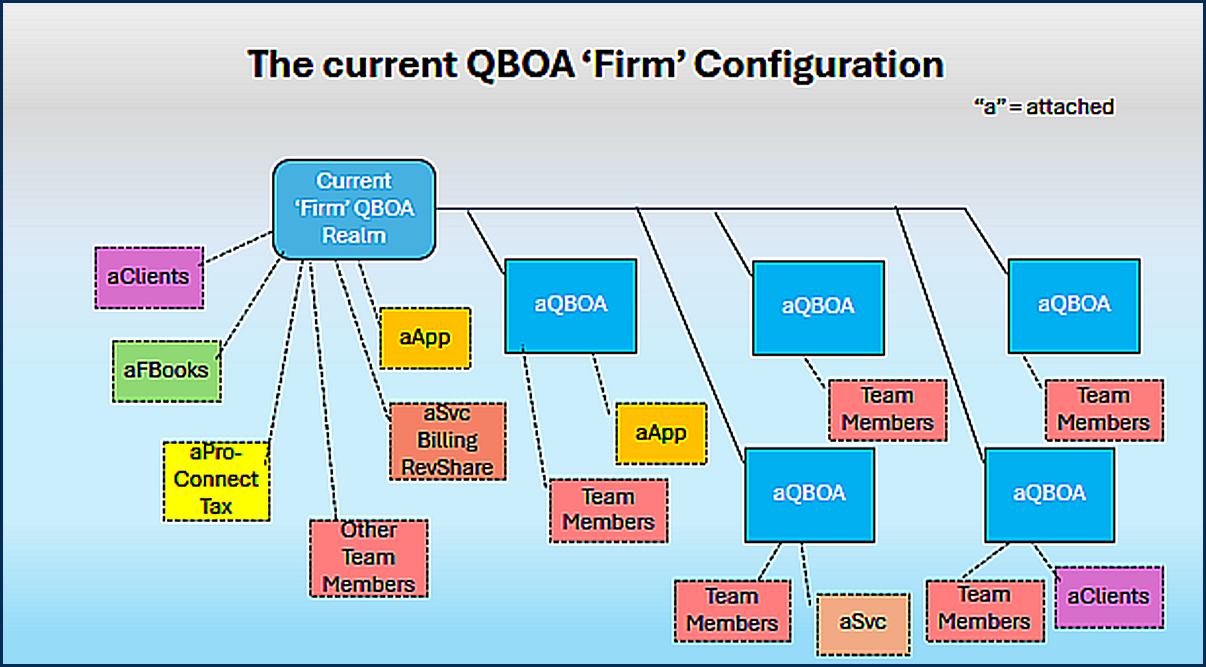
(Illustration of a multi-realm QBO-Accountant-based firm with numerous team members, attached services, and clients attached to more than a single realm.)
One purpose for this webinar is to help you decide if you can effectively 'try out' IAS, or if you should go ahead and transition now. To do that, I will try to ensure you understand (1) what a ‘Realm’ is in QuickBooks Online, and (2) understand the links that exist within the QuickBooks Online environment and ecosystem based on realms.
Beyond that theory, we will (3) examine the practical aspects of ‘realm consolidation’ that most Accounting firms using QuickBooks Online-Accountant will need when they are ready to migrate to Intuit Accountant Suite.
Now, if you understand all of this already, and you are certainly not going to have problems following Intuit's five steps for conversion:
- Planning for realm consolidation,
- Preparing the target realm that will become the seat (primary realm) of your IAS,
- Migrating client (source) realms to the primary (target) realm of your IAS seat,
- Performing post-migration clean-up, and
- Beginning work under the new IAS platform.
I've seen at least four Intuit presentations on this process, but as of yet, I've never seen an Intuit Representative go all the way through the process in a 'live demonstration' setting.
But, during tomorrow's QBTalks-Apps Show, I plan to actually demonstrate the process for transitioning from QBO-Accountant to Intuit Accountant Suite.
I will also have some nifty PowerPoint slides (like the one above), talking points that outline the steps to keep me on track. Still, the webinar's primary purpose is to teach how to transform your QBO-Accountant-based firm into an Intuit Accountant Suite firm.
If you are already registered for QBTalks, you are automatically registered for the new QBTalks-Apps series. If you are not already registered, you can:
Register Here for QBTalks (and QBTalks-Apps)
I look forward to seeing you tomorrow at QBTalks-Apps: "A Realm By Any Other Name." (Murph)
Disclosures:
Some content within this article, and in the corresponding webinar, is based on Intuit source materials including in-product 'Help' and actual QuickBooks Online Accountant and Intuit Accountant Suite, technical support release notes. Intuit content adapted by Insightful Accountant from Intuit sources is furnished for educational purposes only.
As used herein, Intuit, QuickBooks Desktop products (QBO and QBO-Accountant), as well as Intuit Accountant Suite, refer to one or more registered trademarks of Intuit® Inc., a publicly-traded corporation headquartered in Mountain View, California.
Any other trade names or references used herein may refer to registered, trademarked, or copyrighted materials held by their respective owners; they are included in the content for informational and educational purposes only.
This is an editorial feature, not sponsored content. No vendor associated with this article has paid Insightful Accountant or the author any form of remuneration to be included within this feature. The article is provided solely for informational and educational purposes.
Note: Registered Trademark ® and other registration symbols (such as those used for copyrighted materials) have been eliminated from the articles within this publication for brevity due to the frequency or abundance with which they would otherwise appear or be repeated. Every attempt is made to credit such trademarks or copyrights within our respective article footnotes and disclosures.