
Figured has undergone numerous enhancements since I first wrote a First Look feature a few years back and that's why it's appropriate for us to take 'Another Look' at this agricultural management software and the advisory opportunities it affords.
Over my nearly 30-year QuickBooks career, I have cringed a few times when I got an email or phone call from a QuickBooks user who wanted help setting up their ‘agricultural’ business, even though I’ve been involved with agriculture in one way or another much of my long life.
I had a grandfather who had hundreds of acres, and raised cattle and horses, and almost exclusively grew all the grass the animals ate. So yes, it's been in my blood which the IRS refers to farmers or ranches with it ‘just in their blood’ as “hobby farmers.”
Nevertheless, despite my understanding of crop rotation, USDA administered payments, Co-op programs, and the maturation of livestock, I still had a hard time turning crops into numbers except when you sold what was farmed or raised. And the idea of Dairy farming, milk production and selling cow's milk seemed like booking revenues from out of nowhere.
Then you take accounting software like QuickBooks and find even though it offered ‘Agriculture, Ranching or Farming’ within a list of industries to help you set up a new company, the Chart of Accounts it populated hardly matched the terminology either used by farmers or ranchers, or the 32 lines (plus sublines: a,b,c, etc.) found on the IRS Schedule F. In fact, it seems like the IRS said, “let’s make a list of all the ways farmers and ranchers get paid by the government as revenue, then subtract the same expenses that most other forms of business have, and call it ‘a good guess of what an agricultural business makes in a year’."
Well, when a farmer or rancher had a 160 or 320 acres and a few head of cattle, or grew a limited number of crops, or milked a dozen or so cows, that might be a ‘good guess’ but the reality is today that almost all of the 1.8 million ‘small to mid-sized’ U.S. family farms need more than that kind of accounting. They need accounting advisory services to help them achieve profitability and turn small into something much more than that.

The reality is that agricultural businesses have undergone both hard times, and bad raps. We’ve all been told that ‘the American Farm(er) is a dying breed’ and that ‘America is no longer an agricultural economy’ but nothing is further from the truth. The reality is that America still feeds not only itself, but much of the rest of the world.
What America, and the American Farmer and Rancher need, is an accounting technology that fits the facts… ‘Agricultural business is different’ than manufacturing, retail sales, professional services, and every other type of business, regardless of size.
A few years ago, I wrote a First Look feature on Figured Agricultural Software. I had first seen the software during QuickBooks Connect 2023 in Las Vegas, and interviewed Dave Dobbs who was manning their booth. Subsequently, I reviewed the feature questionnaire Figured submitted and looked at a demonstration based on crop farming, I was delighted that someone had actually designed an app for farming, so I gave it favorable consideration in the First Look feature.
Since then, two things have become obvious. First, Figured has made several enhancements in their product to incorporate a wide range of operational factors including farm/ranch planning into the accounting foundation. Second, there has been a tremendous interest in not only ‘niche specialization’ but ‘niche advisory services’ within the accounting, bookkeeping and consulting community. These two things combine to produce a wealth of opportunity for you, the accountant, bookkeeper, or consultant.
When I was asked to give Figured Agricultural Software ‘another look’, I realized I should also look at more than the ‘accounting aspects’ of the software and consider how its enhanced operational functionalities can generate not only the data that farmers and ranchers need, but also provide the metrics and analytics accountants, bookkeepers and consultants need to provide farmers and ranchers with meaningful advisory services.
Did you know that most family farmers and ranchers don’t even use accounting software, they rely on spreadsheets and notebook ledgers? Heck,I track stock using the 'Ritchey Livestock Tags’ little red book. The farmer down the road uses a little yellow notebook from a company called ‘Field Notes’ to track their crop and crop rotations on their farm. And one of the dairy cattle feed producers hands out a little cream colored ‘Dairy Cow Daily Milk’ notebook, that I’m betting a ton of Dairy farmers use. Collectively, I'm sure these little notebooks, along with a Number 2 pencil, track more agricultural metrics than QuickBooks (or any other small accounting software).
You know all those clients you have that bring you a shoebox of receipts at year end? That’s nothing, farmers and ranchers take their tax preparers several ‘cowboy boot’ boxes containing about 300 times as many receipts. Those receipts, their bank statements, loan statements, and USDA administered payment documents are what makes up the short few hours of their annual ‘advisory’ conversation with a financial professional.
It boils down to the very fact that small accounting software, like QuickBooks or Xero, just wasn’t built for how agricultural businesses, of any size, run. And that becomes evident when you try to use an annualized record of profit and loss.
Take crop growing as an example, a typical crop season isn’t a calendar year long, or even a ‘fiscal year’, it’s closer to a 20-to-24-month production cycle from the time input contracts get signed several months before planning, and the last of that crop's income posts to the books until well into the following year.
Another thing to consider is that many farms are don't just operate a singular focused agricultural business; they graze livestock in some pastures while also growing multiple crops on different parcels of land.
In the U.S. not every calf is born on the start of some imaginary fiscal year, nor do they mature into the same ‘end result’. While some calves will become steers that subsequently are slaughtered for ‘beef’, others will become breeding cows, and a few may be selected to be bulls that will be used for breeding as well.
This year’s newborn calves that become steers (a process we shall not explain here) will become ‘steaks, roasts and ground beef’ about two years down the road. Along the way, the cost of raising them to maturity will change, and their value will also increase over time. When the rancher takes out an insurance policy or loan based on the value of his herd, they had better have a realistic idea of the true worth of that stock.
But, because most farmers and ranchers are still getting only compliance services in terms of tax returns filed and balanced to a set of ledgers somewhere, most likely on the accountant’s computer, those financials they are handed in a neat little ‘prong folder’ with a P&L and their Schedule F based Tax Return does not genuinely reflect the true worth of their operation, nor the metrics of successful performance of their farm or ranch.
But Figured can change all of that. It’s a farm financial management platform used by hundreds of accounting and advisory practices worldwide, tracking more than $30 billion in agricultural debt and 61 million acres of managed farmland. Figured connects a farm's financial data with its production data on one ledger, bringing the farmer, adviser, consultant, and lender into the same picture.
Figured's Reporting Studio turns that combined data into gross margin, variance, and custom KPI reports built once and reused across an entire client portfolio. It also generates the reporting a lender wants to see, before the meeting starts. Then, Auto Analyst, Figured's AI-powered commentary feature, adds a plain-language narrative to those reports automatically. The intent is to not only produce the metrics and analytics that ‘Agricultural Advisors’ can use to provide key information to their farm and ranch clients, but data that makes sense to those farmers and ranchers. In other words, turning ‘compliance’ into ‘advisory.’
Key Features and Benefits of Figured
Before I cover too many more ‘generalities’ of Figured, let’s look at some of the specific features and benefits.
A Tool Made for Agricultural Accounting
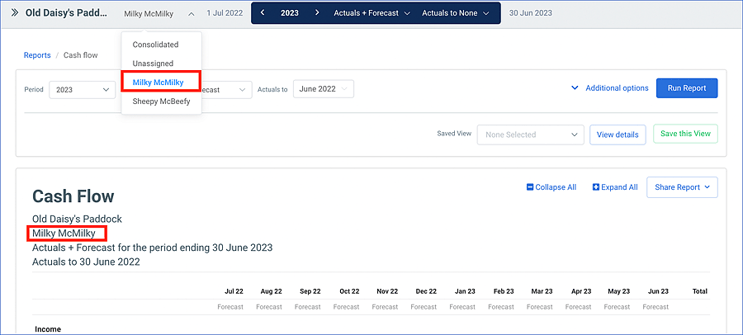
A single connected ledger and workspace: Figured combines QuickBooks Online or Xero financial data with farm production data in one place, so advisers manage every client farm without switching systems or double-handling data.
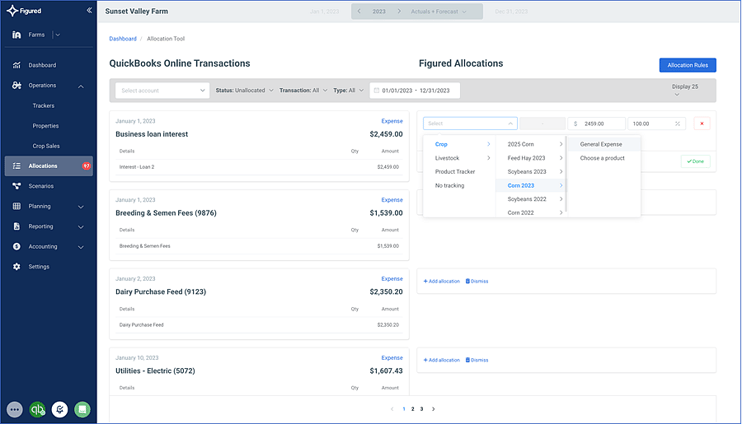
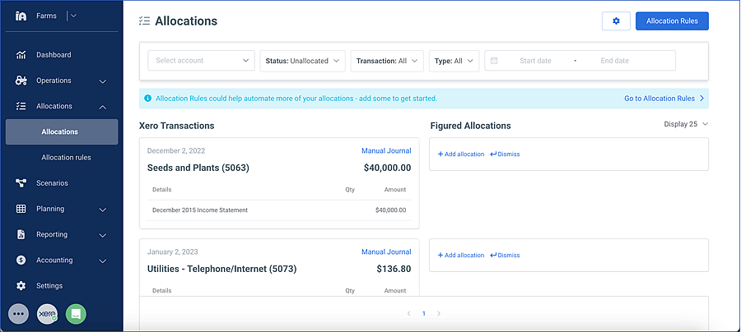
Really Allocating Agricultural Income and Expense
Automatically allocate income and expenses to a farming enterprise, individual field, or crop season using Figured's Allocator.
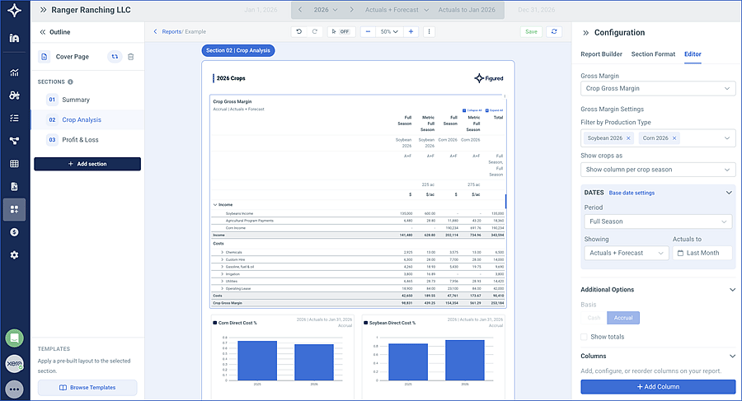
Meaningfully Tracking Agricultural Gross Margins
Gross margin reporting through Figured's Reporting Studio: by crop or enterprise, broken down to per-acre figures (the standard unit US lenders, landlords, and extension budgets already think in) and down to the individual field.
KPIs Designed to Advisor Agricultural Operators
Formula Builder within Figured's Reporting Studio: build custom KPIs once (EBITDA, breakeven, operating expense ratio, or your own) and apply them consistently across every client.
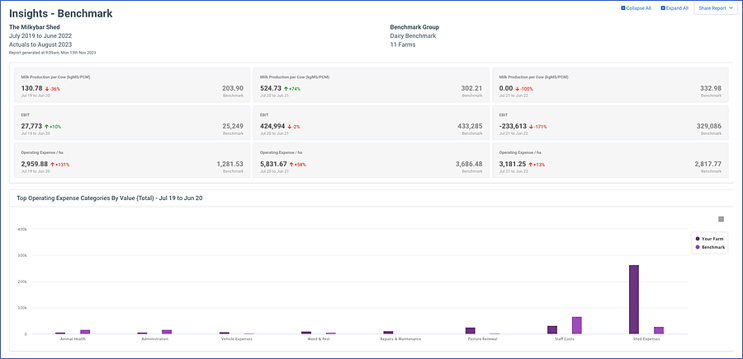
Reporting for the True Lifecycle of Crops and Herds
Accrual-based production reporting aligned to the farm's season, not just the calendar year.
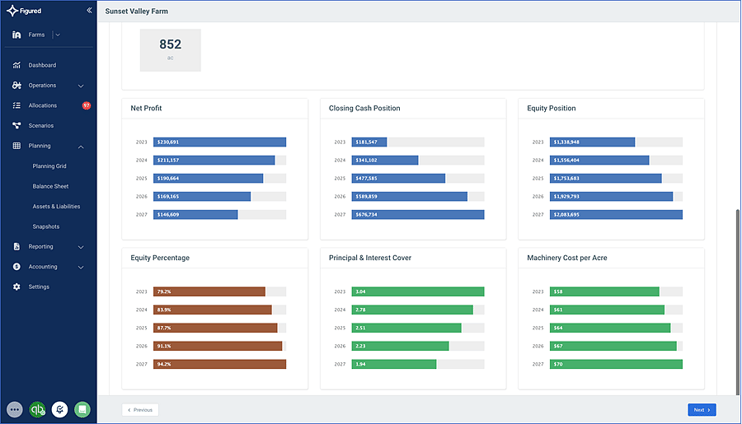
Turning the Numbers into Easy-to-Understand Analysis
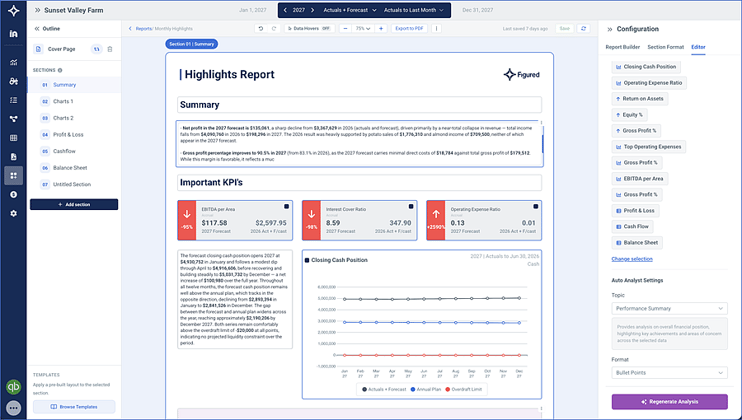
Auto Analyst, Figured's AI-powered commentary feature, automatically generates written analysis within Figured's Reporting Studio, explaining the numbers in plain language for every farm.
Accurately reflecting the Operations’ Budget and Actual Performance
Build annual budgets from existing financial and production data and track variance on an ongoing basis.
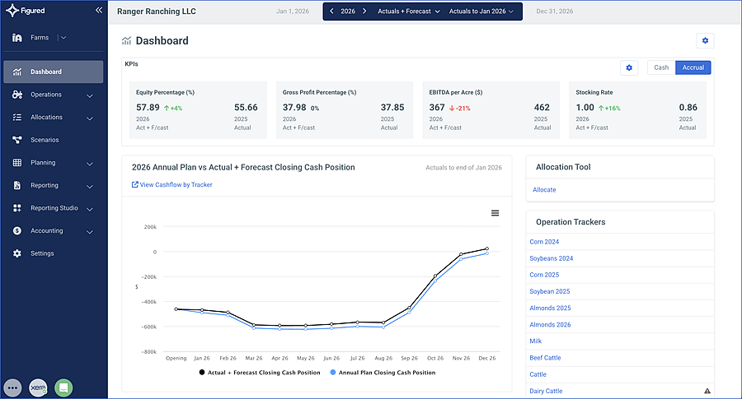
Planning for the Future with Real-world Farm and Ranch Operations
Scenario planning to model the financial impact of succession, expansion, or financing decisions before they happen.
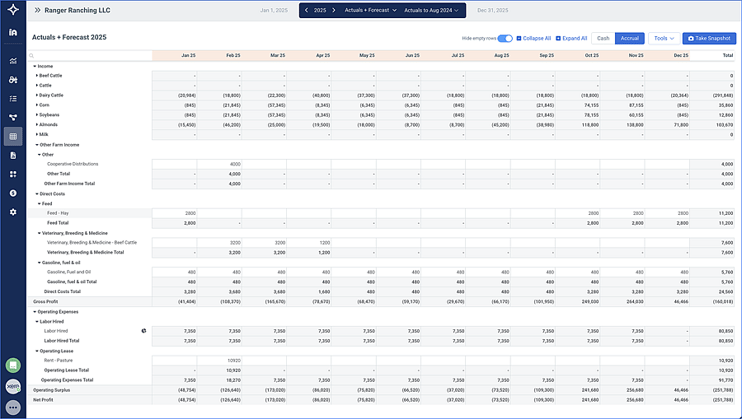
Recognizing that Agricultural Operators Don’t Do Just One Thing
Multi-enterprise, multi-farm, and complex ownership structures supported, without needing separate systems per client.
A Tool Built for the Entire Agricultural Team
Connect the whole farming team: the farmer, adviser, consultant, and lender working from the same live data, each with their own role-based access, and the adviser at the center of the conversation.
Don’t Take Murph’s Word for It
From national firms like Pinion, Eide Bailly, and Adams Brown, to specialized Ag-advisory practices like JC Ag Financial Services and Empire Ag, to smaller CPA firms like Precision Advising, Nadine Julson, LLC, Baker Milligan, Dickinson & Clark, and Erin R. Heath CPA, they all are singing the praises of Figured.
At Pinion, one of the country's largest Ag-advisory firms, consultant Derrick Deardorff says the shift to live, connected data using Figured means his team is "spending much less time looking backwards" and more time looking forward with clients.
Adams Brown, advisor Turner Polzin uses Figured with Xero across the firms’ farm clients, helping those agricultural operations plan and budget with real confidence: "We're good at the numbers, they're good at farming. We put them together (with Figured) and help them make a better business."
Many Ag-specialist advisory practices are incorporating Figured into their core services, not adding it on as an ‘extra.’
Empire Ag uses Figured as its primary tool for connecting client financials to what's actually happening in the field throughout the season, using Trackers and Allocations to see profitability down to the crop, livestock type, or individual field, and using scenario planning with clients to weigh decisions like adding livestock or taking on a new lease before committing to them.
JC Ag Financial Services provides services using Figured to some 110 farms nationwide, from Washington to Maryland, Texas to North Dakota, despite having no website their practice has grown entirely through referrals. Firm owner Jarod Creed, and CFO Jeff Janssen, built a repeatable process around connecting every account at onboarding, allocating every transaction to crop year, crop, and field within 48 to 72 hours, and measuring it against budget continuously through the season. Janssen said, "If we don't have complete information, we're not making 100% accurate decisions."
And mid to large firms specializing in Agriculture are not the only ones taking advantage of Figured, smaller firms are using Figured to take on Agricultural clients in a meaningful way.
Ashly Lindberg grew Precision Advising 20-times over in five years by standardizing one advisory workflow with Figured instead of customizing a process for every client.
Nadine Julson, LLC and Erin R. Heath, CPA are using Figured to move from manual, once-a-year reporting to ongoing advisory services with their agricultural clients built around meaningful metrics like gross margin per head, something smaller ranch and row crop clients rarely had access to before.
What Figured Has to Offer You
About now you might be asking yourself, “It looks like plenty of other accountants, bookkeepers and consultants are already providing services using Figured, so what opportunities are still out there for more Ag-specialists?”
The answer is “plenty!” Near the start of this feature, I mentioned the 1.8 million family farmers and ranchers in the United States. Sure, some of them already have a ‘trusted advisor’ but most of them fall into that category of going to see their tax preparer after the year has ended.
What that means is there are plenty of the 1.8 million who need a trusted advisor with the tool of choice, Figured, to provide them with meaningful measures of their operations’ performance. They want an advisor who can turn numbers on a P&L or tax return into metrics that actually are in a language they can understand, like “what did I end up making for every ear of corn I harvested?”, or “how much did that steer cost me over its entire life cycle, and did I actually make a profit?”
A new niche awaits you, but you must prepare yourself with the right tool and the right knowledge. The right tool is Figured, and the right knowledge begins as soon as August 27th at 12:00 PM Eastern.
On that date, the folks from Figured Agricultural Software will be presenting the first of a three-part webinar series on transitioning from a compliance-based accounting, bookkeeping, tax preparer and business consultant (including ProAdvisors) to an Agricultural specialized advisory practice.
In the first session, you will understand the differences between Agriculture (farming, ranching or dairy) operations and other businesses like eCommerce, or non-profits, or manufacturing or distribution. Those differences want key metrics and require tracking of the real numbers that frequently remain in the crop records, or the dairy production spreadsheet, or the cow-calf notebook and never are valued for a meaningful look at Assets, Liabilities, Profit and Loss.
You can transition from a compliance to Agricultural Advisory practice; the Breadbasket of the World is right here in the USA, ripe for the picking, so to speak. Before long you can be ready to build a practice like none you’ve ever had before and know that you are contributing to those who are raising the food you put on your table, it will change your entire outlook on life.
Register HERE for the August 27, 2026, Agricultural Accounting Advisory webinar.
Disclosures:
Content within this feature, including images, adapted in part by the author from First Look/App Aware on-line survey source materials provided by Figured. Referenced source materials and content appearing within Insightful Accountant are used with permission and are provided solely for educational and informational purposes.
Other trade names including QuickBooks and Xero, or entities, mentioned within this article may refer to products registered, trademarked, or otherwise held by their respective owners. They are hereby acknowledged as such, and are referenced solely for informational and educational purposes.
This article is provided for informational and educational purposes. The publication of this article does not represent an endorsement by either the editors or publishers of Insightful Accountant.
First Look, App Aware and Second (or Another) Look features are offered to developers of FinTech software or apps that integrate with one of the general ledgers which Insightful Accountant covers within the accounting technology space. Developers submit an online questionnaire and provide supplemental information including product graphics. Features are reviewed, and if accepted will be published on a first come, first serve, basis as editorial staffing time permits. For more information, contact the editor.
Note: Registered Trademark ® symbols have been eliminated from the articles within this publication for brevity due to their frequent occurrence. We attempt to credit such trademarked products within our respective article footnotes and disclosures.