
menu
close_24px
Intuit Accoountant Suite AUG, 2026 REGISTRATION

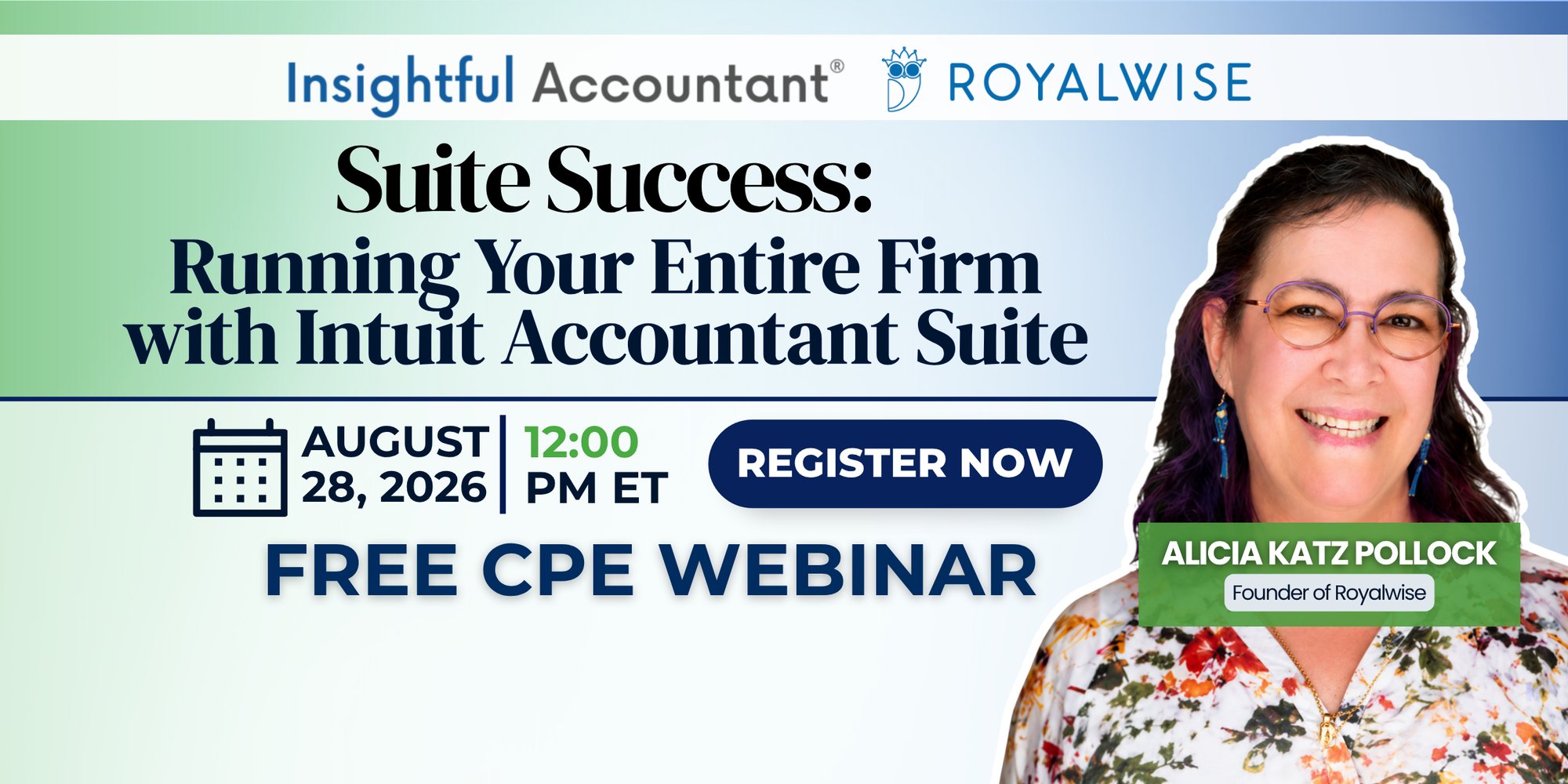
Intuit Accountant Suite

Discover how Intuit Accountant Suite transforms the way accounting firms manage client work. Learn how to gain a complete view of client activity without logging into multiple files, streamline workflows with dashboards and automation, and leverage AI to uncover insights, spot trends, and calculate KPIs. Whether you're a solo practitioner or scaling your firm, this session will help you work smarter and deliver higher-value advisory services.

Register For This Webinar

Overview
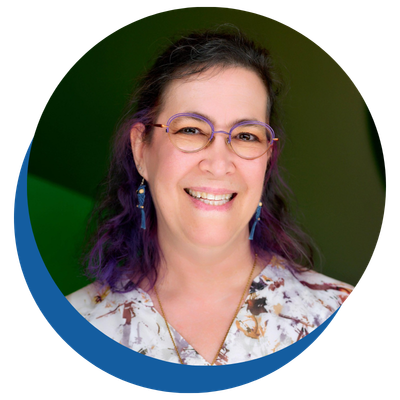
Presenter: Alicia Katz Pollock, MAT, ACN, MOUS
Date : August 28, 2026
Time : 12 PM ET
Duration : 60 mins
Language : English

Speaker's Info

Be Insightful Premium Content

Build Smarter,

Lead Better,

Stay Informed.

SEP
22
TUE
2:00 PM
ET
Who Do You Really Want as a Client? How to Build an Ideal Client Profile That Makes Your Marketing Easier
BeInsightful

Who Do You Really Want as a Client? How to Build an Ideal Client Profile That Makes Your Marketing Easier

Not every client is the right client for your accounting firm. Yet many firms market themselves to virtually anyone who might need bookkeeping, accounting, or tax services. The result can be unfocused marketing, generic messaging, and a client base that doesn’t necessarily support the type of firm you want to build. In this interactive session, we’ll explore how to identify the clients you want more of and use that knowledge to make better marketing decisions. Attendees will learn how to evaluate their existing client base, recognize the characteristics of their best-fit clients, and distinguish between an Ideal Client Profile (ICP) and a buyer persona. Through practical examples, polls, and exercises, participants will begin developing their own ICP and persona and learn how to apply them to their website, content, referrals, email, social media, and other marketing activities. Attendees will leave with a practical framework they can continue using to sharpen their marketing and attract more of the clients they actually want. Learning Objectives By the end of this session, participants will be able to: Identify the characteristics, needs, problems, and behaviors that distinguish a firm's best-fit clients from its broader potential market. Develop an Ideal Client Profile and buyer persona using a structured framework based on client attributes, needs, buying triggers, fit, value, and potential red flags. Apply an Ideal Client Profile and buyer persona to improve marketing decisions, including messaging, website content, referral strategies, content development, email, and social media.

SEP
23
WED
12:00 PM
ET
The CAS Opportunity:  CAS is the Future
Premium

The CAS Opportunity: CAS is the Future

Discover why firms are rapidly shifting from compliance to advisory and why CAS has become one of the fastest-growing revenue opportunities in the profession. Learn what CAS actually is, what it isn't, and the mindset required to build a modern advisory practice.

SEP
24
THU
12:00 PM
ET
The Truth About Doing Taxes With AI
BeInsightful

The Truth About Doing Taxes With AI

Speaker: Dr. Christine Gervais AI is already showing up in tax prep, review, and planning workflows this season — but between vendor hype and horror stories about client data leaks, most practitioners still don't know what's actually safe to do with it. This session cuts through the noise. We'll start with realistic, practical ways to use Claude Cowork on real client work — organizing source documents, drafting review notes, building planning scenarios, and speeding up research — alongside the specific settings that protect sensitive taxpayer data while you do it: permission and approval modes, connector and file access controls, and data handling settings. Then we'll cover what has to change outside the software: how firms should be evaluating cyber liability and technology E&O coverage now that AI tools touch client data, what engagement letter language actually protects you when AI assists with a deliverable, and how your WISP needs to be updated under IRS Pub. 4557 and the FTC Safeguards Rule to reflect AI use. Upon completion of the webinar, participants should be able to: Distinguish realistic uses of AI in tax prep, review, and planning from unsafe or overhyped uses Identify and apply the Claude Cowork settings that reduce risk when sensitive taxpayer information is entered (permissions/approval modes, connector and file access controls, and data handling settings) Evaluate whether their firm's current WISP meets IRS Pub. 4557 and FTC Safeguards Rule expectations for AI tool use, and identify the specific updates needed Draft or evaluate engagement letter language that discloses AI use, sets client expectations, and supports firm risk management Assess potential gaps in cyber liability and technology E&O coverage related to AI use, and identify the right questions to bring to their insurance broker

SEP
24
THU
2:00 PM
ET
The Daily Sales: Serving Up Data from the POS to the Books
Pro

The Daily Sales: Serving Up Data from the POS to the Books

Your restaurant client's day starts and ends with the POS. But "just record the daily sales" gets complicated fast once delivery apps, comps, tips, and multiple platforms enter the picture. This session walks through building a daily sales workflow that's fast enough to be useful and trustworthy enough to act on. All without chasing a precision the client doesn't actually need.

SEP
28
MON
2:00 PM
ET
Jan's Favorite AI Things
Pro

Jan's Favorite AI Things

Think Oprah's Favorite Things, but for your firm. Jan pulls back the curtain on the AI tools she's actually running her company on right now, the picks that made the cut and why, plus what's next on her radar. Part tool showcase, part behind-the-scenes look at how she evaluates AI so you can do the same in your own practice.

SEP
29
TUE
12:00 PM
ET
Beyond the P&L: Uncovering True Profitability For Agriculture Clients
Premium

Beyond the P&L: Uncovering True Profitability For Agriculture Clients

A standard profit and loss statement is built for filing taxes, not for making decisions. On a farm running multiple enterprises — corn, soybeans, cattle, and more — that gap matters more than most accountants realize. Most farmers can't say which part of their operation is actually making money. Most of their accountants can't either, yet. This session goes deep on enterprise-level profitability: what it is, why a blended P&L masks it, and what additional data — beyond what comes out of standard accounting software — is needed to see it clearly. We'll look closely at one of the most overlooked factors in farm profitability: on-farm movement, where crops or feed never leave the operation and never show up as sales revenue, distorting the real picture of which enterprise is carrying the business and which one is dragging it down. You'll see how a small number of additional data points — yield, acreage, livestock movement — can unlock enterprise-level gross margin reporting without requiring a farmer to overhaul their record-keeping. We'll also cover how reporting that's accurate and current does double duty: it drives better advisory conversations, and it's the same reporting a lender wants to see when a client needs financing, expansion capital, or a loan renewal. This session builds on Session 1 but doesn't require it — if you're already having the advisory conversation with farm clients, or stepping into one for the first time, this session gives you the next layer: knowing what's actually driving (or hurting) the bottom line, enterprise by enterprise. Learning Objectives Understand why a standard P&L from QuickBooks masks enterprise-level profitability on a farm Identify the additional data points (beyond accounting data) that reveal true farm profitability Learn how on-farm movement — where crops or feed stay within the operation — changes the numbers See how enterprise trackers in Figured work and how little data is actually required Know how to use gross margin conversations as an advisory entry point or upsell

SEP
30
WED
2:00 PM
ET
When AI Does the Bookkeeping: Where Accountants Create Value Next
Premium

When AI Does the Bookkeeping: Where Accountants Create Value Next

Speaker: Dyanna Salcedo, CEO, The CFO Project Sponsored: The CFO Project The amount of income you can earn from doing compliance work is decreasing. Since AI can now be used to categorise transactions and reconcile accounts faster than you can, and since the initial draft of the variance report is efficient as well, accuracy and speed have become the entry requirements rather than the services you provide. During this session, Dyanna Salcedo, CEO of The CFO Project, goes through a real client file and explains the process that is followed. She then asks AI a question regarding what the owner should do in the next quarter. The response that AI gives is refined and does not alter any of the decisions the business owner should make. Dyanna then notes the reasons for this, and the main reason is not that the AI model is weak. You will be able to identify among your own service offerings those that are at risk of generating less revenue and determine how to test any AI output before it is given to a client. Learning Objectives: After this session, participants will be able to: Identify the difference between the compliance work AI is actively standardizing and advisory work that still requires professional judgment. Explain why falling compliance prices only serves to increase the value of your judgment. List the three failures that occur in the advisory outputs produced by AI and give the reason why a model lacking essential context resorts to general best practices. Sort your own revenue by whether the work is rules-based versus judgment-based and backward-looking versus forward-looking. Apply the professional blueprint required when using client data with an AI tool, including input security and verification of any calculations.